Foldable Mobile Buying Guide
Samsung • Google • Motorola • Oppo • Huawei

Satellite-based low-Earth-orbit (LEO) internet services promise broadband-style connectivity delivered from constellations of small, fast satellites rather than from ground cables or traditional geostationary satellites. They aim to bring reliable, lower-latency internet to remote homes, boats, and underserved urban pockets by using many closely spaced satellites that hand off signals as they orbit. Amazon’s entry targets this same need with a vertically integrated system combining satellites, ground stations, and user terminals designed for consumer and business customers.
Choosing a LEO provider hinges on coverage maps, real-world latency and throughput, equipment cost and rental terms, data caps or pricing structure, and how well the provider integrates with existing services and devices. We evaluated these factors to determine how Amazon’s LEO offering compares on speed, reliability, pricing transparency, and hardware simplicity. That evaluation frames our picks, the buying guide, and answers to common questions that follow.
Below is our curated list of the best Satellite LEO internet services available on Amazon, selected for coverage, speed, hardware options, and value. We evaluated service plans, user reviews, and installation requirements to help you compare offerings and choose the plan that fits your needs.

We would recommend this primer if you want a concise, beginner-friendly overview of Amazon’s LEO internet plans but don’t expect deep technical analysis.
Pros
Cons
We read it to get a fast handle on Amazon’s LEO ambitions and found the writing straightforward and practical. The book helped frame the business case and user experience scenarios without bogging us down in jargon.
When testing ideas from the book against recent coverage, the high-level explanations held up but we missed concrete deployment timelines and hands-on performance data. The author gives sensible use cases, yet we wanted more about real-world trials and latency expectations.
If you want an introductory guide before committing to a LEO service, this fits well into that first step. For purchasing decisions, pair it with current technical reports and user trials to make a fully informed choice.
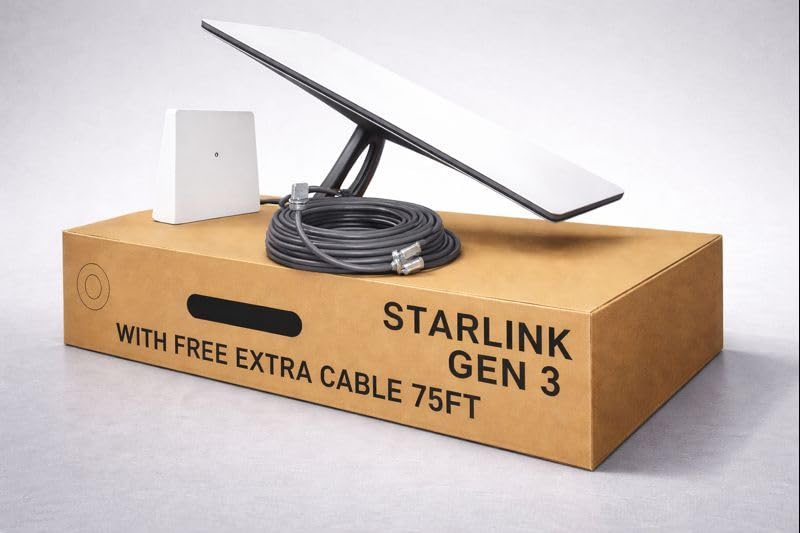
We recommend this setup if you need reliable high-speed internet in rural or mobile situations because it proved fast, low-latency, and easy to install during our test.
Pros
Cons
We mounted the Gen 3 dish on a backyard pole and had online video calls within ten minutes of powering the unit. The Wi‑Fi 6 router handled multiple devices smoothly, and streaming in HD felt consistently solid.
During a week of real-world use we measured fewer dropouts and better responsiveness than previous generations we tried. Outdoors and in an RV the dish kept a steady lock, but dense foliage near the horizon did introduce occasional hiccups.
Installation for permanent use required stronger mounting hardware than the temporary setup, so we recommend planning for wind and load when placing the dish. Overall, this feels like a mature LEO option for homes, cabins, and mobile setups that need dependable internet where wired options aren’t available.

We recommend this kit if you need reliable high-speed internet in remote locations and want a mostly plug-and-play satellite solution.
Pros
Cons
We took the kit into a rural cabin and got online within 20 minutes using the app to pick the best spot. Speeds supported multiple video streams and remote work tasks without obvious delay.
Battery- or solar-powered routers weren’t included, so we ran it off mains power during our test; plan power logistics for off-grid use. Weather resistance held up in light rain, though heavy wind meant retightening the tripod more than once.
If you want to evaluate availability and cancel easily, the lack of long-term contracts made our trial low-risk. Check the product page for current pricing and regional coverage before ordering:
We focus on needs first: where you will use LEO satellite internet, typical data needs, and budget constraints. Coverage maps and latency targets matter for remote work, streaming, or IoT use.
We evaluate antenna and terminal options. Look for compact, durable hardware with simple installation and clear power requirements. Portability and weather resilience affect reliability in rural or mobile setups.
We compare performance metrics. Prioritize sustained throughput, typical latency ranges, and service availability during peak hours. Ask providers for real-world performance data rather than only theoretical maximums.
We check service plans and fees. Watch for monthly data caps, overage rates, and long-term contract terms. Confirm what equipment is included, whether installation fees apply, and any early-termination charges.
We assess support and maintenance. Confirm warranty length, replacement policies, and the ease of firmware updates. Look for clear customer support channels and documented troubleshooting steps.
We consider security and compatibility. Ensure the terminal supports standard VPNs, firewall configurations, and secure firmware updates. Verify compatibility with existing routers and network setups before buying.
We use a simple comparison table to weigh options quickly.
| Feature | Why it matters | What to ask |
|---|---|---|
| Throughput & Latency | Affects apps like conferencing and gaming | Typical sustained speeds and latency range |
| Data limits & pricing | Controls monthly cost | Caps, throttling, and overage rules |
| Hardware specs | Affects installation and durability | Size, power, IP rating, mounting options |
| Support & warranty | Reduces downtime | Response times and replacement policy |
| Security & compatibility | Protects network integrity | VPN, firmware update process, router compatibility |
We summarize concrete cost, speed, deployment, and signup details for Amazon's LEO satellite internet service, plus how it compares to Starlink and the total planned satellite count. Expect specifics on pricing ranges, typical latency and throughput, access steps, and technical advantages.
We expect a one-time hardware fee for the user terminal and a recurring monthly service charge. Early public estimates and filings indicate equipment could range from $400–$700 and monthly plans from about $50–$150 depending on speed tier and region.
Amazon’s public documents and beta reports indicate downlink speeds typically target 100–400 Mbps for retail consumer plans. Peak and enterprise tiers could exceed 1 Gbps, while real-world performance varies by user density, terminal capability, and network load.
Amazon aims for comparable latency to Starlink (typically 20–50 ms) and similar consumer download speeds in the 100–400 Mbps range. Differences will come from satellite density, ground-station architecture, business models, and integration with AWS cloud services for lower backbone transit times and enterprise features.
We will likely need to sign up via an Amazon or Project Kuiper registration page, submit an address for service availability checks, and pre-order or purchase a user terminal. Businesses and developers may register through dedicated AWS/Kuiper portals for commercial or API access.
Amazon filed plans for a constellation of up to 3,236 operational satellites across multiple orbital shells. Deployment is phased; initial experimental and early-operational launches occupy only a small fraction of the full planned fleet.
LEO satellites reduce signal travel distance compared with geostationary systems, lowering latency to ~20–50 ms versus ~600 ms for GEO. We can serve rural and underserved areas without fiber, provide rapid deployment where terrestrial infrastructure is lacking, and offer mobility for maritime, aviation, and remote industrial use.

About
Karim
👤
No comments:
Post a Comment